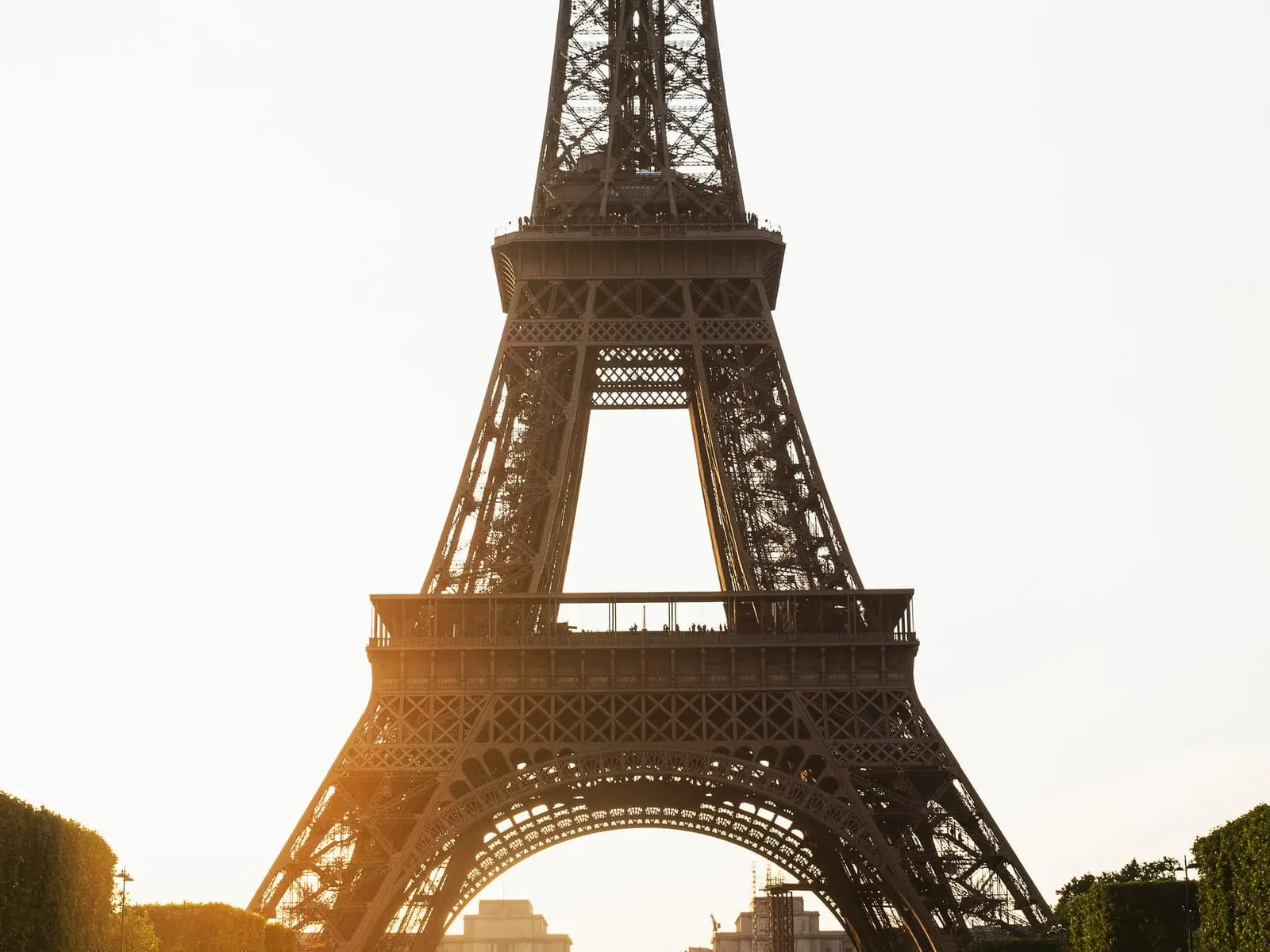
Why an Eiffel Tower session in Paris starts at dawn
Stand at the foot of the tower and all you capture is latticed iron overhead. It needs distance and the right angle before it reads as itself, and the handful of spots that give both are exactly where everyone else heads after breakfast. By nine, each has a queue of people taking turns in the same frame.
At half past six it is a different place. The esplanade is open, the bridge is quiet, and the light comes in low and soft across the river. That hour is the entire product.
The four vantage points, in walking order
We usually begin on the Trocadéro terraces, which give scale: you in the foreground, the whole tower across the Seine. Then down to the Pont de Bir-Hakeim, where the repeating arches of the bridge frame it in a more graphic, intimate way. From there, a side street where the tower appears squeezed between two apartment buildings — the shot that looks like a local took it. We finish on the Champ de Mars, far enough back that the tower sits whole above the lawns.
All four are within walking distance, so ninety minutes covers them without rushing or a single taxi.
Sunrise through the year
The useful window at the Trocadéro and Bir-Hakeim is roughly from half past six to half past seven, adjusted to the season’s sunrise. October is the comfortable choice: dawn arrives at a humane hour and the city’s plane trees are turning. Midsummer means a very early alarm. February is grey but nearly deserted, and the tower in light mist or after rain has a moody elegance some couples prefer.
Ninety minutes and what €240 covers
We send a precise meeting point at the Trocadéro and the time, then guide you through each position — where to stand, how to move, when to look at each other rather than the camera. Forty-five retouched photographs reach your online gallery within 48 hours. The session costs €240 upwards, and guests staying in Issy-les-Moulineaux, Boulogne-Billancourt or Neuilly-sur-Seine pay no travel supplement.